 English
 Română
A bridge does not become durable because the design report contains a service-life target.
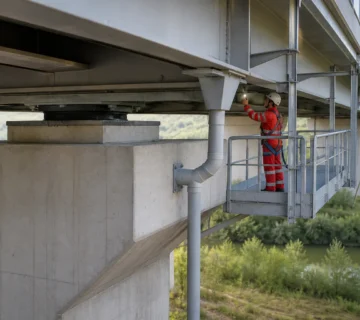
Durability is decided in the places that receive less attention in a presentation: the deck edge where water runs, the joint above an abutment, the bearing that will eventually need replacement, the reinforcement around a congested detail and the narrow space an inspection team is expected to enter years later.
Good bridge design treats these details as part of structural performance. Strength is essential, but a bridge also has to remain usable, inspectable and repairable while weather, traffic and maintenance conditions act on it.
Start with the environment the bridge will actually face
Two bridges with a similar span can experience very different deterioration. Traffic volume, de-icing salts, moisture, temperature cycles, industrial exposure and the ability of surfaces to dry all influence material behaviour.
The design team needs a realistic picture of that environment. A generic material specification cannot compensate for a detail that traps contaminated water. Increasing concrete strength alone does not solve poor compaction in congested reinforcement. A protective system is useful only if the surface can be prepared, applied and inspected correctly.
The European Commission Joint Research Centre describes durability as one of the major concepts of the Eurocodes, alongside safety, serviceability and quality assurance. Its overview notes that deterioration should not impair performance when the anticipated level of maintenance is considered. The official summary of these Eurocode design concepts is a useful starting point; the applicable standards and National Annexes remain project-specific.
E-SFlows provides bridge design services for road and pedestrian bridges, culverts and composite structures, with durability considered from concept through detailing.
Water is often the route by which small defects become expensive
Water carries salts and contaminants into joints, cracks and porous surfaces. It freezes, washes fines from unprotected areas and reaches bearings or substructures that are difficult to clean. Where it remains trapped, the structure has less opportunity to dry.
A durable drainage arrangement begins with surface falls. Water then needs a continuous, visible route through inlets and pipes to a discharge point that does not wet structural faces or create erosion below. Each transition deserves attention. A beautifully detailed pipe is of little value if the inlet sits above the true low point.
Deck drainage also has to work with the adjoining road. Approach levels, kerbs, safety barriers and expansion joints influence flow. Close coordination with the road design team prevents the bridge drainage from ending at the abutment without a workable continuation.
Concrete durability is also a detailing and execution problem
Material selection, cover and crack control matter, but the drawing must also be buildable. Reinforcement that is technically correct yet impossible to place and compact around creates its own durability risk.
Congestion often appears near anchorages, diaphragms, joints, bearing zones and changes in section. A three-dimensional review can help, but it should be supported by a practical discussion with people who understand fixing, formwork, concrete placement and inspection.
Construction tolerances need similar realism. If a drainage component or bearing plinth works only at one exact millimetre, the detail may be too fragile for site conditions. Design should identify which dimensions are critical and provide adjustment where appropriate.
Steel needs a complete protection strategy
For steel and composite bridges, protection is more than selecting a coating system. Geometry controls whether water and debris collect on flanges, around stiffeners or at bolted connections. Access controls whether the surface can be inspected and renewed.
Closed details can reduce exposed surfaces, but they introduce their own requirements for sealing, internal environment and inspection. Open details may be easier to see but harder to clean. The appropriate solution depends on the bridge, fabrication method and maintenance strategy.
Edges, welds, bolts and interfaces with concrete deserve explicit attention. These are not decorative refinements. They determine whether the specified protection can be applied with the required continuity.
Joints and bearings need a replacement story
Movement joints and bearings perform necessary work, but they are also common maintenance points. A joint may sit directly above concrete surfaces and bearings, allowing leakage to affect both. A bearing may be accessible for visual inspection yet impossible to replace without major traffic disruption.
At design stage, the team should consider:
- how water is collected if a joint leaks;
- whether debris can be removed without dismantling adjacent elements;
- where inspection staff can stand or attach safely;
- where jacks can be positioned and how loads are transferred during replacement;
- whether movement indicators or reference points remain visible;
- what traffic management a future intervention will require.
Even where replacement is unlikely for many years, reserving space now is far cheaper than creating it later.
If a component cannot be inspected, its condition becomes an assumption
Inspection access should follow the actual route a person or piece of equipment must take. A hatch on a drawing does not prove that it can be opened, reached safely or used while the bridge remains in operation.
Box girders, abutment galleries, bearing shelves, drainage outlets and areas below deck joints all need a practical access review. Lighting, ventilation, fall protection, confined-space conditions and rescue may matter depending on the arrangement. External inspections may require platforms or vehicle-mounted equipment, which affects traffic management and clearance.
Access also needs to survive later modifications. Utility additions, barriers or acoustic screens should not close the route to a critical structural component.
Simple geometry can be a durability advantage
Every unnecessary ledge, recess and narrow gap creates another place for dirt and moisture to remain. Simpler details are often easier to fabricate, construct, inspect and maintain.
This does not mean every bridge should look or behave the same. It means complexity should earn its place. A detail introduced for structural efficiency should be considered alongside its effects on drainage, protective systems, tolerances and future access.
The same principle applies to the number of components. Fewer joints and bearings may reduce maintenance, but the resulting structural system has to accommodate movement and construction constraints correctly. Durability is a balanced design decision, not a single rule.
Execution records become part of the bridge’s future
The owner will eventually need to understand what was built: concrete batches and tests, reinforcement changes, weld inspections, coating records, bearing settings, drainage checks and as-built geometry. If that information is incomplete, later assessments begin with uncertainty.
During construction, professional site supervision supports verification of critical stages before they are covered and helps maintain a traceable record of accepted work and resolved deviations.
Photographs are useful when they are identified by location and date. A folder of unlabelled images is not a substitute for a structured quality record.
A practical durability review before issuing the design
- Can water leave every surface without crossing or wetting vulnerable components?
- Are concrete details placeable and inspectable at the specified cover?
- Can protective systems be applied and renewed at edges and connections?
- Can joints, bearings and drainage components be cleaned, inspected and replaced?
- Are jacking positions and temporary load paths defined where needed?
- Do access routes remain safe when the bridge is carrying traffic?
- Does the maintenance assumption match the owner’s realistic resources?
Durable bridge design is not a promise that nothing will require maintenance. It is a plan that makes deterioration slower, visible sooner and manageable when intervention becomes necessary.
Frequently asked questions
Does a higher-strength material automatically make a bridge more durable?
No. Material performance matters, but exposure, cracking, drainage, detailing, workmanship, protection and maintenance access also influence durability.
Why plan bearing replacement during original design?
Because bearings may eventually require intervention. Reserved jacking positions, load paths and working space can turn a difficult future operation into a planned one.
Can E-SFlows coordinate bridge and road drainage?
Yes. The bridge and approach drainage can be developed as one route for water, with responsibilities and scope agreed for the project.